The Capsize Comfort Value is calculated:
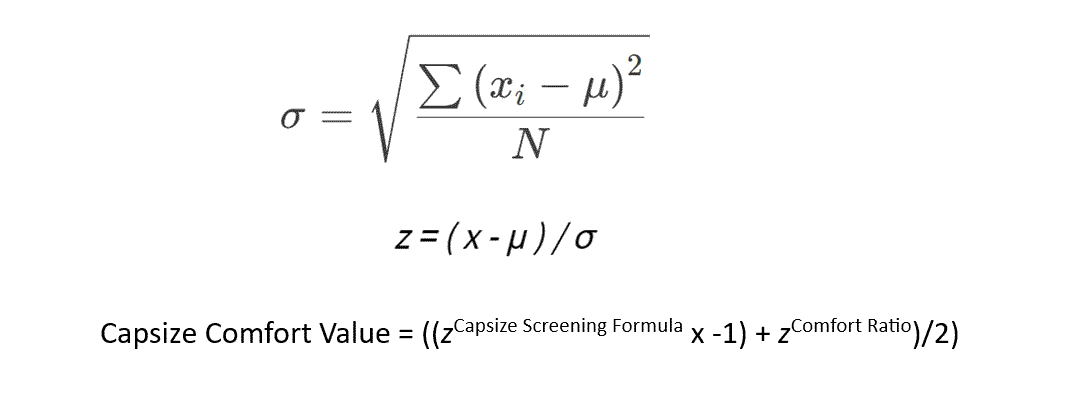
For each boat the Capsize Screening Formula and Comfort Ratio are included in the Capsize Comfort Value (CCV).
The Capsize Screening Formula and Comfort Ratio are converted to z-scores, in turn by determining the mean (μ) and standard deviation (σ) for each. The Capsize Comfort Value (CCV) of a boat is the mean of these 2 z-scores for same boat (while taking into account the direction (positive or negative) in which each criteria loads on Capsize Comfort Value (CCV) (the higher the Capsize Comfort Value the more seaworthy the boat).
The z-score tells us how far above or below the mean a boat’s score is on each of the criteria, expressed in units standard deviation (σ). Put differently, the raw scores were in different units in the different criterion. The z-scores are all in the same unit, that is, in standard deviation (σ).
Thus, each z-score and the resulting Capsize Comfort Value (CCV) for each boat draws on the values of the complete population of the over 8000 boat models included in the calculation. That is, the exact Capsize Comfort Value (CCV) for a specific boat cannot be calculated without letting it influence all the other CCV values for all the other boats in the population.
Interpretation:
A higher number indicates a higher resistance to capsize and a more comfortable boat, making the boat more suitable for offshore passages. A value of 0.35 or higher is often recommended for offshore sailing. However, there are more valid and reliable measures – read more.